Corporate Governance Standards Rising in Colombia
A model code of corporate governance, the Codigo del Pais, has been promulgated by the Superintendency of Companies and under the auspices of a Chamber of Commerce program. The process is speeding the adoption of and adherence to modern corporate norms.
Modern corporate governance standards promote efficient and transparent investment by ensuring predictable, efficient, and fair corporate conduct. They are important to attract and reward passive or minority investors. Colombia’s history of conditions of violence and reported corruption, and of insular family and syndicate corporate operations, make it especially beneficial to demonstrate this kind of transparency in order to attract foreign capital for growth and development.
The new Colombian Model Code is not compulsory. Rather, each exchange-listed company or public securities issuer must adopt its own code of corporate governance, and disclose it, and explain its divergence from the Model Code. This approach differs from previous post-Sarbanes Oxley attempts to imposes a compulsory, one-size-fits-all, rules-based approach. Listed companies and securities issuers are required to adopt a code and disclose or explain the code and how it departs from the model. Different standards apply to listed companies than non-listed issuers and family companies as well as SMEs or PyMEs. Nevertheless, through IDB and IFC financing, and other means, corporate governance codes are being adopted increasingly throughout all types of firms.
The IFC has gathered several resources on Corporate Governance.
Among them is the Program for Corporate Governance for Colombia of CONFECAMARAS and CIPE (Colombian Confederation of Chambers of Commerce, and the International Center for Free Enterprise of the U.S. Chamber of Commerce) which issued their Report on Growth, Financing, and Corporate Governance. This is a (Spanish-language) white paper and the model national code, produced in the “Principles and Point of Reference for the Development of a Code of Good Corporate Governance.” The white paper was developed by a committee whose members were: Asofondos (the Colombian Association of Pension and Retirement Fund Administrators), the Colombia Stock Exchange, Bogota Chamber of Commerce, Cartagena Chamber of Commerce, Confecámaras, KPMG, Dinero Magazine, Spencer Stuart, and Juan Carlos Varón.
The white-paper report version of the code [English Translation Needed] consists of the following major sections:
- Rights and equitable treatment of shareholders;
- Roles and responsibilities of the Board;
- Transparency, fluidity and integrity of information;
- Interest groups in society and social responsibility;
- The chief executive;
- Conflicts of interest; and
- Administration and dispute resolution.
In addition to IFC, IDB unit Inter-American Investment Corporation (the IIC) has funded lender BBVA (as reported on this site) for corporate governance improvements in Small and Medium-sized Enterprises, or SMEs in Latin America and in particularSMEs/PyMEs, .
The Corporate Governance Website established by Confecamaras and CIPE publishes valuable information, including the model corporate governance code [English translation needed] as issued by the Superintendencia Financiera (Circular Externa 028 of 2007 – Annex 3), which contains the following major sections:
Introduction
- General Assembly of Shareholders
- Board
- Disclosure of financial and non financial information
- Dispute resolution
- Glossary of Terms
Annex 1. Country Code survey. Code of Best Corporate Practice, Colombia
Annex 3. Mandatory questions by type of issuer
The Corporate Governance Website also provides some English-language explanation of the corporate governance code and development process and the “comply or explain” approach of these rules. For example, there is a helpful write-up of The VI International Corporate Governance Forum in Colombia in a report entitled “The Corporate Governance in the International Agenda: A Glance to the Latin American Advances and Challenges.” The site also links to a good overview from the 2007 Meeting of the Latin American Corporate Governance Roundtable, in Medellin, in a report entitled “Country Report: Voluntary Corporate Governance Code in Colombia.” The Corporate Governance Website also mentions the following book-form publications available [English translations needed]:
- Perspectivas Legales de Gobierno Corporativo en Colombia (Legal Perspectives on Corporate Governance in Colombia)
- Experiencias Exitosas de Gobierno Corporativo en la Región Andina (Successful Experiences of Corporate Governance in the Andean Regio)
- Libro Blanco de Gobierno Corporativo (White Paper on Corporate Governance)
- Lineamientos para un Código Andino de Gobierno Corporativo (Guidelines for an Andean Code on Corporate Governance)
- Gobierno Corporativo: Todo lo que el empresario debe saber (Corporate Governance: What you should know as the employer)
- Estudio de Casos de Buenas Prácticas de Gobierno Corporativo (Case Studies of Good Corporate Governance Practices)
- Guía ética para la Gestión en Pymes (Guide to Ethics Management in SMEs)
- White Paper de Gobierno Corporativo en Latinoamérica (White Paper on Corporate Governance in Latin America)
Among the companies that have adopted the code based on the model national code are:
- Cementos Argos
- Bancolombia
- Empresas Publicas de Medellin
- Inversura
- Titularizadora
- Ecopetrol — which has its own chapter/case study in the book: Estudio de Casos de Buenas Prácticas de Gobierno Corporativo — has a Code of Ethics to which it refers in its SEC Form 20F (annual report) description of corporate governance.
- Bavaria as discussed in a 2007 IFC Report
- Finandina (Financiera Andina) S.A.
“Growth, Financing and Corporate Governance: The Growth Process of Bavaria, a Company with a Global Vocation”
There are two slightly older Reports on the Observance of Standards and Codes on Corporate Governance and the related topic of Accounting and Auditing.
Foreign Arbitration In Colombia and Enforcement Issues
In the “flat” world that New York Times columnist Thomas Friedman describes, investors, entrepreneurs, and businesses need a reliable legal system to enforce contracts efficiently and minimize unforeseen or unforeseeable outcomes. Investors stay away from countries where their contractual rights are illusory because they cannot be enforced. Foreign arbitration is the state of the art, as it also ensures a fair shake for foreign investors and locals alike.
Colombia has taken many steps toward modernization of its legal regimes to attract foreign investment. For example, legal stability contracts (contratos de estabilidad juridica) are available to insure against adverse changes in laws and regulations upon which investment decisions are based.
The Colombian legal system rates only a 2 on a scale of 4 according to the Latin America Venture Capital Association (LAVCA) 2008 Scorecard. The LAVCA scorecard rates Colombia 1 on a scale of 4 for perceived corruption, stating that although the judiciary is highly regarded, its lower levels and those of the civil service are susceptible to corruption and intimidation. The World Bank’s Control of Corruption Indicator paints about the same picture.
The same 2008 Scorecard, however, says foreign arbitration is “broadly permitted” (though there is “no relevant experience with international arbitration in private equity investments,” according to LAVCA).
Two useful overviews have been published recently by prominent Bogota lawyers. Daniel Posse Velasquez & Carolina Posada, of Bogota law firm Posse & Herrera, write in their article “Colombia Arbitration” in the Latin Lawyer (available by searching for “arbitration” at the “News” tab of that firm’s website) that there has been positive change in Colombia’s laws relating to foreign arbitration. A similar questionnaire-response format report was published by the Global Arbitration Review by German Marin of Cavelier Abogados.
The Colombian laws on arbitration and other helpful links can be found on the Latin Laws website. Law 315 of 1996 provides the framework, and Decree 1818 of 1998 (link is in Spanish) modernized the law to protect and enhance the viability of foreign arbitration awards.
Arbitration agreements must be in writing and signed both by the claimant and by the party against whom enforcement is sought. Colombian law does not permit an arbitral tribunal to assume jurisdiction over disputes unless all parties are signatories to a written agreement. The contract must give the name and domicile of the parties, the conflicts that will be subject to arbitration, and the process to be followed when applicable. The signed written contract may be a stand-alone arbitration agreement or it may contain an arbitration clause. Arbitration agreements may be prospective or may deal with an existing dispute.
All disputes that parties have the private power to resolve by agreement may also be resolved by arbitration.
Disputes involving securities issuers are strongly encouraged to be settled by alternative dispute resolution. (Regulation 28 of 2007.)
International arbitration is available only where at least one party is not a Colombian national.
Legal stability contracts are not subject to international arbitration (only domestic arbitration) under Law 963 of 2005 (Art. 7).
In arbitrations with state-owned entities, Law 80 of 1993 Article 70 states that arbitration may not resolve the legality of administrative acts or the legality of the application of “exceptional powers” of administration (i.e., unilateral interpretation, unilateral modification, unilateral termination and continued usefulness or “caducity” of the public contract. Arbitration may resolve, however, the economic effects thereof. How does this work in practice, however? Is foreign arbitration with a state entity ever really viable? Domestic arbitration?
In international arbitration, parties are free to select the nationality and number of the arbitrators as well as the method of their designation. Parties may select the language for international (but not domestic) arbitration. Arbitrators in international arbitration need not be Colombian citizens or residents. If the arbitration is under law, however, the arbitrators must be lawyers, but if it is in equity, they may be non-lawyers.
Colombian courts will enforce arbitration agreements to the same extent they enforce all contracts. Arbitration agreements are severable from the contracts that contain them.
The Bogota Chamber of Commerce operates domestic and international arbitration (in conjunction with the International Chamber of Commerce).
Foreign arbitral institutions may hold an arbitration proceeding with its seat in Colombia.
Arbitrators may adopt interim measures (claim registrations and seizures) in disputes of property rights, but not preliminary awards or interim relief.
Colombian courts have no jurisdiction over arbitration proceedings or procedure except to determine the validity and existence of an agreement to arbitrate and require the parties to submit to arbitration.
The time it takes to enforce an arbitration award may be lengthy, but is better than trying to enforce a foreign judicial award, and better than resorting to Colombia courts.
Colombian courts generally take considerable time to resolve contract disputes. The process is comprised of 34 procedures and takes an average of 1346 days to conclude.
Bankruptcy reform is said to have increased the efficiency of the bankruptcy system in Colombia by reducing reorganization costs, making reorganization an attractive option for distressed but viable firms.
To be enforced, arbitration awards must be confirmed before the Supreme Court in an “exequatur” proceeding which typically lasts 1-2 years. This proceeding determines the validity of the arbitration award. Only thereafter is execution on the award permitted.
LAVCA’s 2008 Scorecard reports that bankruptcy laws are “adequate” but enforceability is “problematic.” A new bankruptcy law was created in December 2006 to shore up existing restructuring mechanisms that seek to make liquidation a last resort. LAVCA reported on a 2008 proposal to separate secured assets from the general assets of a firm in liquidation.
LAVCA reports that shareholder agreements must be structured carefully to solidify limited liability.
What Lies Ahead in 2009?
Some interesting items in the news show the struggle to assess the direction of the current economic climate in Colombia.
Stimulus Plan Unveiled For Consumer Mortgages
Bankers Are Pleased With Mortgage Stimulus Plan
Oil Services Investments in ’09 Are Expected to Fall
Oil Revenues in Colombia Anticipated to Fall by Half
Nouriel Roubini Sees “Difficult” 2009 In Colombia
Colombia asks for $10.4 billion credit line from IMF
Colombia says to substitute loans for bond sales
Area For Colombia Construction Permits Down 33% In Feb On Year
Ruta del Sol – The Bogota/Carribean Highway Is One of Latin America’s Largest Infrastructure Projects
Said to be second only to the Panama Canal expansion project, the infrastructure megaproject known as the “Ruta del Sol” or “Sun Road” has major financing in place, the project is approved, and was recently tendered for bids. This post takes a high-level look at the Ruta del Sol and asks what it will mean for future economic development along its route, including tourism facilities, agri-business, manufacturing, business process outsourcing, transport, and real estate development.
Remember that where much of its population lives, Colombia is extremely mountainous. Driving on these highways (as I have), it is often more important to look at profile or relief maps than the overhead kind. Long steep inclines and repetitive switchbacks along simple two-lane roads mean that the existing highways are punishing for commerce and even worse for tourism.
Ruta del Sol will run west then north from Bogotá, starting at over 9,000 ft elevation (2640m). From there it will plunge down through the ridges and canyons of the Eastern Range of the Andes in Central Colombia into to the humid valley of the mighty Magdalena River (<500m). It will achieves more than one mile in elevation drop in just the first 50 road miles. Ruta del Sol will end seaside by the Caribbean at the Ye de Cienaga (literally, the fork in the road at La Cienaga), between historic Santa Marta and the busy port of Barranquilla. There, the Ruta del Sol will meet up with the Highway of the Americas connecting to Cartagena. Along the way are major intersections feeding traffic to the coffee zone, Medellin, and Valledupar on the Venezuelan border.
The highway/bridge/tunnel project will require feats of engineering. On overhead maps, the Ruta del Sol resembles a central artery of circulation, even a spinal cord. But, it is vital to see how the project uses viaducts and tunnels to slice through mountains and fly over canyons. This helpful presentation, in English, at proyectorutadelsol.org, helps to explain it all. Check out the cool video and this newscast video.
Will it be a vital economic and social tool? As violence has been receding in recent years, Colombians took to the highways, first in protected “caravans,” and now with plenty of visible security on rural roads, to reach their beloved fincas (farms) and the playas (beaches) of the north. The highways are choked with 60% commercial traffic, meaning much of what is made and shipped in Colombia travels this way — very slowly, very dangerously. Current roads are serious barriers to development as well as social improvement and peace. The need is great.
The strategy makes a lot of sense. Colombia has used public works and transportation in particular to great effect to solidify gains against the narco-violence. Examples include the Bogotá Project — building the Transmillenio surface transit system in Bogotá — and the modern metro and skyward cable cars in Medellin. Another highway project connecting Cali/Buenaventura (the Pacific port town) with Bogotá and Venezuela to the east, was also recently announced, and another, called the Mountain Highway System, is in the planning stages in the Antioquia state around the industrial city of Medellin. The road projects call to mind the US Interstate Highway System, which opened the US interior and connected its major cities and coasts with cheap, fast, flexible transit.
Though some financing is now in place, serious challenges lie ahead, given the world economic situation. Financing that has been announced includes the IDB’s US$1.3Bn for Colombia superprojects, chiefly the Ruta del Sol. The announcement came from IDB President Luis Alberto Moreno and Colombian Home Minister Oscar Ivan Zuluaga during the IDB’s 50th Annual Meeting, in Medellin (see prior post). Also in late March, Conpes, the nation’s economic and social policy council, announced its approval of the project, and Inco (Instituto Nacional de Concesiones, the Transport Ministry’s concessions authority) announced it was let out for bid by March 24. Here is a story on La Republica about it in Spanish.) Expected bidders are said to include Conalvias with Impregilo and Bancolombia, according to Business News Americas. La Republicareports eight consortia are interested, with investment levels of US$7.5Bn, including three Colombian and two Brazilian groups. Financing for these consortia, however, beyond Bancolombia’s presence, is as yet unknown.
Details were revealed in December 2008 for achieving the three segments of the 1000-km, US2.6Bn Ruta del Sol project, including new tunnels, viaducts, toll and access points, and double-lane expansions of the roadway. The sheer scope and size of the project suggests that enormous legal bureaucratic hurdles lie ahead, in addition to the engineering and financing. In 2007, the Government chose the IFC as its financial advisor, and Bogata law firm Posse Herrera & Ruiz (partner Jose Alejandro Torres and partner Alessia Abello) was selected the legal advisor. (See note on LatinAmericanNetwork.com.)
The big slide presentation (linked above) also has up-to-date facts on the investment environment in Colombia generally and touted some large recent investments, including:
- South Africa’s SABMiller’s acquisition of the Bavaria brewer, at US$4.17Bn (2005)
- Alabama-based Drummond Coal doubling of coal production facilities. at US$1.5Bn (2006)
- Switzerland’s Glencore Investment’s acquisition of the Ecopetrol refinery in Cartagena for US$2Bn (2007)
- Brazil’s Votorantim US$490M acquisition of a 52% stake in the Paz del Rio steel plant (2007)
- Philip Morris’s US$300M acquisition of Coltabaco (2005)
The route maps, some technical information, and the like are included in the 62 highly-detailed slides.
IFC’s contacts in Washington, DC, are:
Richard Cabello, Senior Investment Officer, International Finance Corporation, Tel: +1 202 458 8825, rcabello@ifc.organd Ari Skromne, Investment Officer, International Finance Corporation, Tel: +1 202 473 0484, askromne@ifc.org.
In Bogota, contacts are:
Maria Victoria Guarín, Investment Officer, International Finance Corporation Tel: +57 1 319 2372, mguarin@ifc.org, and Faice Gutiérrez, Investment Analyst, International Finance Corporation, Tel: +57 1 319 2353, fgutierrez3@ifc.org
In addition to the sources mentioned above, check out this and other Business News Americas stories. They seem to have gotten the best scoops on this lately in the English language press. This post is drawn from a variety of Spanish-language sources as well, including information on the Proyecto Ruta del Sol website.
Two Colombians in the news, according to Latin Finance, are Angela Maria Camacho, at Microsoft, now head of legal and corporate director for Latin America, and Andres Otero, who moved from Kroll Consulting’s Bogota office to its Miami office to head Latin America for Kroll. According to Latin Finance:
Ángela María Camacho has been named as legal and corporate director for Latin America for Microsoft. Before joining Microsoft, she worked as a vice president of legal affairs for AT&T in her native Colombia. She has also held positions with British Petroleum and Shell.
Andres Otero has been named head of the Miami office of Kroll’s Consulting Services, where he will work with clients in Latin America and elsewhere. He joined Kroll in 2003 and opened the Kroll Bogota office in June of 2006 as Colombia Country Head. Prior to Kroll, he co-founded Colombian risk consultancy Corporate Investigations.
Chinese Take Increasing Interest In Colombia
Huang Zhilong from the Institute of Latin America, a think-tank that is part of the Chinese Academy of Social Sciences, says China will cautiously buy more Latin bonds, including IDB bonds, to support economic recovery and development efforts. Huang also said that China hopes to increase use of the Yuan to settle Sino-Latin debt, following a recent currency swap with Argentina that made it easier for Argentina to buy Chinese goods (using Yuan instead of expensive dollars).
The IDB says China will fund one public and one private partnership. El Colombiano is reporting that China wants to help build the Pescadero Ituango (Ituango Fisherman) hydroelectric project planned in Antioquia.
Fulbright & Jaworski’s Laura McMahon, co-chair of the law firm’s Latin America Practice Group, said in a recent Latin Business Chronicle story that “We’ve been doing deals between China-based companies and Latin America for several years, but this past year I’ve seen more deals than I’ve seen in prior years.” (See the full article, which is only partly available without a subscription.)
Nouriel Roubini’s RGE Monitor also takes note that top Chinese officials are traveling in Latin America this week as China “tops the list of emerging Latin American trading partners.”
BBVA Gets Funding for SMEs and Corporate Governance
The BBVA bank group has obtained financing from IDB unit Inter-American Investment Corporation (the IIC) to fund the development of Small and Medium-sized Enterprises, or SMEs, in the region.
We will be interested in following the funding to identify transactions financed under this program. Please post a comment or send a message if you have information or would like to contribute to this blog.
Here is the headline and a clip from the press release:
Medellín, Colombia – On March 27, 2009, BBVA and the Inter-American Investment Corporation (IIC), the only multilateral finance institution mandated to support and provide financing for SMEs in Latin America and the Caribbean, signed a cooperation and technical assistance agreement for establishing targeted action areas to support the development of SMEs in the region.
This strategic partnership will enable the IIC to channel flows of funding, as well as nonfinancial value-added services, through BBVA South America to enterprises in the region. Nonfinancial services will consist primarily of performing diagnostic reviews of companies under the IIC’s FINPYME® program (www.FINPYME.org), promoting SME energy efficiency under the IIC’s GREENPYME program, and fostering good governance practices among family-owned companies.
Inter-American Development Bank Meets in Medellín
 What would happen if you called a major economic summit meeting in a city once notorious for its violence as a worldwide economic recession rages? As it turns out, an enormously important and successful summit, and a lot of changed opinions.
The 50th Annual Meeting of the Inter-American Development Bank (IDB) took place this weekend in Medellín, Colombia. The “Medellin Model” (linked site is only in Spanish so far, but see the IDB statement on the Medellin Model exhibition that is on display during the meetings. As the LA Times has noted, the city is polished up to show its guests a wonderful time. The guests have returned the favor.
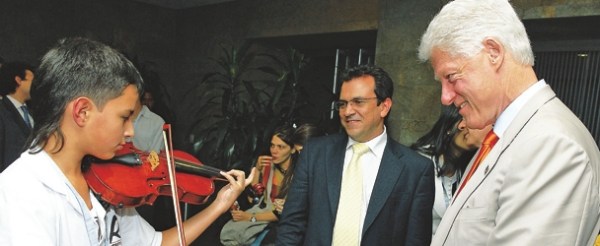 Headliner Bill Clinton spoke of priorities: “For the price of a necktie you could send a child to school for a year. Everything depends on your priorities.” He also acknowledged that no one is capable of saying when, or where, we will emerge from the crisis, but we will emerge, so long as we rely on long-term strategies and a healthy financial system, in addition to short-term stimulus. The former President’s conversation with IDB President Luis Alberto Moreno took place before a packed house of more than 2000 in the Metropolitan Theater. The locals, who call themselves “Paisas,” were thrilled.
China’s Central Bank Governor Zhou Xiaochouan acknowledged the uncertainty as to when the global financial crisis hits bottom and its link to when China’s economy will have hit bottom. He also said he is looking forward to seeing US Treasury Secretary Timothy Geithner in Medellin on Sunday March 29. He also indicated firm support for multilateral institutions including the IDB. Zhou also foreshadowed his country’s anticipated G-20 Summit Meeting position in calling for greater regulatory reform. And he spoke of a huge potential for economic ties through substantial foreign direct investment in Latin America, particularly pharmaceuticals, software, aeronautics, and biological products. China is the region’s third largest trading partner, with trade having risen an annual average of 30% since 2001, according to Zhou, rising from $15Bn to $140Bn. Other headliners include Nobel Prize-winning economist Robert Merton, whose talk emphasized using technology as a bridge to the economy of the future, and Intel Chairman Craig Barret.
 Treasury Secretary Geithner and Colombian President Alvaro Uribe also spoke.
The IDB Newsroom includes headlines of stories worthy of further review and dissemination. For example, the BBVA bank group has financing from IDB unit IIC to fund the development of Small and Medium-sized Enterprises, or SMEs, in the region: “BBVA And The IIC, A Multilateral Finance Institution That Is A Member Of The IDB Group, Sign Agreement To Support Business Governance In South America”:
Medellín, Colombia – On March 27, 2009, BBVA and the Inter-American Investment Corporation (IIC), the only multilateral finance institution mandated to support and provide financing for SMEs in Latin America and the Caribbean, signed a cooperation and technical assistance agreement for establishing targeted action areas to support the development of SMEs in the region.
This strategic partnership will enable the IIC to channel flows of funding, as well as nonfinancial value-added services, through BBVA South America to enterprises in the region. Nonfinancial services will consist primarily of performing diagnostic reviews of companies under the IIC’s FINPYME® program (www.FINPYME.org), promoting SME energy efficiency under the IIC’s GREENPYME program, and fostering good governance practices among family-owned companies.
360-degree Views of Medellin
Okay, so it is neither law nor business, but you have to admit these are pretty nifty.

Library of Spain
GeoAmericas.org is celebrating the 50th Annual IADB meetings in Medellin this weekend with numerous panoramic shots at each of several beautiful sites in Medellin. The Metro is featured (especially the sensational Metrocable, a public aerial cablecar system part of the public transit), but the real winners are, in CLBB’s humble opinion, the library parks, or parques bibliotecas, of which there are several.
The best known (deservedly so) is the Library of Spain, or Biblioteca de Espana, high above northern Medellin in the barrio of Santo Domingo Savio. Once the very epicenter of murder and violence, it is a triumph of modern architecture by Giancarlo Mazzanti, from Barranquilla, a jewel high above the valley, at the top of the Metrocable. With apologies to Woody Allen’s “Bullets over Broadway,” this place represents the triumph of “books over bullets.” (Keep watching this psace for news of an important visitor to the library from a major NY cultural institution.)
Latin Finance reports (subscription required, the report is partial without a subscription) that the Colombian government has selected a bid by Ashmore Investment and Inverlink as managers of an infrastructure fund created by the government and the IDB. Macquarie Capital is to be the technical advisor. The winning bid was one of five submitted. Projects are expected in sanitation, telecommunications, transport, energy, and logistics. Bancoldex (Banco de Comercio Exterior de Colombia) will be a 50% investor in the fund, which is formed as a private equity fund (or Fondo de Capital Privado, FCP). The remaining 50% is divided equally between IDB and the Andean Development Corporation (Corporacion Andina de Fomento, CAF). With loans to the fund, Colombian government financing, and other private investment, plans are for $22Bn to be spent on more than 100 infrastructure projects.
More information on this fund and its plans can be gleaned from the Environmental and Social Report on the IDB’s website.
Abu Dhabi Investment Fund Mubadala Eyes Colombia
According to this report in Semana (in English), the Abu Dhabi fund Mubadala is eyeing investment in Colombia. The $10Bn Abu Dhabi state investment promotion arm is looking in Colombia at the sectors which it considers its strengths: infrastructure, oil, energy, real estate, telecommunications, tourism and health. Mubadala has taken a $2.1Bn interest in Spain’s Indra, an 8% stake in micrprocessor maker AMD for $622M, a 7.5% stake in Carlyle Group for $1.35Bn, and interests in Rolls Royce and Ferrari, among others.
The Mubadala visit came after President Uribe and Minister of Foreign Trade and Investment Luis Guillermo Plata visited the United Arab Emirates in October, which in turn followed their meeting at the Davos World Economic Forum with Sheikh Mohammed Bin Zayed Al Nahyan, Abu Dhabi’s prince and president of Mubadala.
LA Times Reports Medellin Cleans Up Its Act
Add the L.A. Times to the growing list of major news institutions heralding how the people of Colombia have turned a corner on the violence. As usual, the 90+% drop in the murder rate is featured. And the famously clean, quiet Metro and skyward Metrocable. This story also features a link between the IADB meeting and Medellin, the $580M IADB-financed sanitation project that cleaned up the Medellin river and installed modern sewage treatment.
Fair Trade Lending — Shared Interest Has Successful Trip
Cruising around the web today for some interesting material I came across this blog posting from last fall about fair trade lending.
The author is Hugo Villela, Market Development Executive – Central America for Shared Interest, and he writes about his recent trip to Bogota and Armenia. Shared Interest describes itself as follows:
Shared Interest is a co-operative lending society that aims to reduce poverty in the world by providing fair and just financial services. We have been part of the fair trade movement for 17 years and work extensively with community-based businesses in Africa and other continents to help them make the most of fair trade. We work primarily by providing finance up front to producers, often via their buyers, to enable them to buy raw materials, tools and the other things they need at the time they need them. We also offer longer term loans and other credit facilities to support the development of fair trade businesses. We currently have more than 8,500 members who have invested over £22 million to allow us to make a range of financial services available to fair trade producers and the businesses that buy, market and retail their goods.
A good thing, wouldn’t you say?
Visiting Colombia, Hugo reports that he was able to have successful meetings with ProExport, the Ministry of Foreign Trade and Investment, as well as the Bogota Chamber of Commerce. Hugo writes that “there are not many micro or alternative lending companies operating in Colombia,” but he was “able to determine that we can legally operate in Colombia as well as raise our profile in the region.” He also attended “Let’s Talk Coffee,” in Armenia, which he says:
assembles farmers, cooperative leaders, roasters, industry visionaries, market analysts, and business experts, providing a forum for 250 participants from thirteen countries to receive industry-specific training, listen to expert presentations designed to help improve supply chain quality, and share best practices among peers (from the Sustainable Harvest website).”
Coffee is big in Colombia, and so is fair trade, so Shared Interest’s success is wonderful to hear about. Villela also met with Fruandes (Frutos de los Andes) during his trip, which has made a success of its fair trade approach.
I would like to hear and share more. I am developing a post about micro-lending and alternative financing in Colombia. Please post any suggestions.
The Topics This Blog Covers
This post will explain the topics this blog will focus on. I will try to separate posts, links, and material according to certain sections corresponding to the major topics I will be covering. Here are the sections I will be developing:
News and Views
I will periodically highlight items of general interest on law and business in Colombia.
Economy, Finance, Trade and Development
This section will draw attention to matters of interest to foreign investors and visitors about Colombia’s economic, finance, trade, diplomatic, and political developments, like the Free Trade Agreement (the FTA, known in Colombia as the Tratado de Libre Comercio, or TLC). Other finance issues will also be covered such as microcredit and fair trade. I will also try to feature specific Colombian businesses, including those with activities outside of Colombia such as Bancolombia and Grupo Argos, the Medellin cement company with extensive operations in Mexico and the US. This area will collect, organize, and identify useful links to American and Colombian government agencies, business and finance media, and other sources on doing business in Colombia.
Private Equity (Fondos de Capital Privado).
The purpose of this section is to feature the work of various private equity funds that have been formed to acquire, grow, and sell businesses in Colombia. This section will also help disseminate information about legal strictures, dispute resolution issues, and specific transactions that learn about. Contributors will be invited to supply information, for example FCPs will be welcome to post information and links to their transactions, portfolio companies, managers, investors, and other information.
Legal Issues and Developments
I am particularly hopeful that this will be a forum to share information about the operation of the Colombian commercial legal system in connection with international investment. It will try to feature Colombian lawyers and law firms available to help international investors, and American firms like my own that are interested in transactions having to do with Colombia. Firms and attorneys will be invited to identify topics of discussion and to post information and links to their activity.
What About Drugs and Violence?
At one time, virtually every headline in English one could find about Colombia concerned drugs or violence. This site is not going to attempt to provide insights or reporting on these subjects, because they continue to be well-covered in other forums.
Will There Be Spanish Language Content?
Of course! When it comes to Colombia, there will have to be some Spanish language content, but don’t worry, my goal is to provide access in English too.
Welcome!
On the occasion of the 50th Annual Meeting of the Inter-American Development Bank in, of all places, Medellin, I was inspired to start a blog.
This major gathering of financial and political leaders from Latin America and around the world has brought together headliners like Bill Clinton, Timonthy Geitner, Arnold Schwarzenegger, and People’s Bank of China Governor Zhou Xiaochuan. It is fitting that this beautiful city that has worked so hard to modernize and bring peace should host such a major meeting. It is a testament to how far things have come, and what a wonderful place Medellin is.
Colombia today excites a lot of attention in the business community. The purpose of this blog is to provide an English language site to collect and increase the dissemination of information about commercial activity and investment in Colombia and related legal issues. The purpose is also to draw attention to the wonderful people of Medellin whose economic, social, and cultural development work is healing the violence of the past and ensuring a rich future in a beautiful land.
So please enjoy the material and add any suggestions for additional content or links that will help our readers.
 Hunter T. Carter